A Complete Enterprise Learning Series for Spring Boot Developers
“Writing microservices that work is easy. Writing microservices that continue working when everything around them fails is engineering.”
Introduction
Modern enterprise applications no longer run on a single application server. They execute as hundreds of containerized microservices distributed across Kubernetes clusters, often spanning multiple availability zones and cloud providers.
While Kubernetes has made deploying applications significantly easier, many Java developers still write applications as if they are running inside a traditional JVM on a single server.
Unfortunately, production environments are far less forgiving.
Pods restart unexpectedly.
Containers get killed due to memory pressure.
Nodes disappear.
Network latency spikes.
DNS changes.
Dependencies become unavailable.
Messages arrive more than once.
Entire regions can fail.
The applications that survive these failures are not simply “running on Kubernetes.” They are designed for Kubernetes.
This blog series focuses on building those applications.
Rather than explaining Kubernetes commands or YAML files alone, this series bridges the gap between Java development and cloud-native platform engineering, helping Spring Boot developers understand how application design, Kubernetes, OpenShift, Service Mesh, and observability work together to create truly self-healing systems.
Who Should Read This Series?
This learning path is designed for:
- Java Developers
- Spring Boot Developers
- Microservice Architects
- Event-Driven Developers
- Technical Leads
- Solution Architects
- DevOps Engineers moving into application development
- Developers preparing for enterprise Kubernetes/OpenShift projects
Basic Java and Spring Boot knowledge is sufficient. No prior Kubernetes experience is required.
What Makes This Series Different?
Most Kubernetes tutorials teach how to deploy an application.
Most Spring Boot tutorials teach how to build an API.
Very few explain how applications behave after deployment, especially when failures occur.
This series focuses on designing applications that continue operating during failures by combining four complementary layers.
The Four Layers of Self-Healing
                    ┌──────────────────────────────┐
                    │      Business Services       │
                    │  Account | Payment | KYC     │
                    └──────────────┬───────────────┘
                                   │
                    ┌──────────────▼───────────────┐
                    │      Spring Boot Layer       │
                    │ Retry │ Health │ Cache │ API │
                    └──────────────┬───────────────┘
                                   │
                    ┌──────────────▼───────────────┐
                    │ Kubernetes / OpenShift       │
                    │ Pods │ Scaling │ Recovery    │
                    └──────────────┬───────────────┘
                                   │
                    ┌──────────────▼───────────────┐
                    │      Service Mesh            │
                    │ mTLS │ Routing │ Telemetry   │
                    └──────────────┬───────────────┘
                                   │
                    ┌──────────────▼───────────────┐
                    │ Observability Platform       │
                    │ Logs │ Metrics │ Traces      │
                    └──────────────────────────────┘
Each layer contributes to resilience, but no single layer is sufficient on its own.
Running Example Throughout the Series
Instead of isolated code samples, every article builds upon the same enterprise banking application.
The application consists of multiple event-driven microservices communicating asynchronously while running on Kubernetes.
                Customer Portal
                       │
                 API Gateway
                       │
     ┌─────────────────┼─────────────────┐
     │                 │                 │
Customer Service   Account Service   Payment Service
     │                 │                 │
     └──────────────┬──┴─────────────────┘
                    │
               Kafka / Solace
                    │
      ┌─────────────┼───────────────┐
      │             │               │
 Notification   Fraud Engine   Audit Service
Every subsequent article enhances this architecture with production-grade capabilities.
Learning Roadmap
Foundation
- Cloud Native Principles
- Containers
- Kubernetes Fundamentals
- OpenShift Basics
Kubernetes
- Pods
- ReplicaSets
- Deployments
- StatefulSets
- Services
- ConfigMaps
- Secrets
- Probes
- Autoscaling
Spring Boot for Kubernetes
- Health Indicators
- Graceful Shutdown
- Stateless Services
- Idempotency
- External Configuration
- Connection Pools
- Resource Management
Event Driven Architecture
- Kafka
- Solace
- RabbitMQ Concepts
- At-Least-Once Delivery
- Duplicate Messages
- Dead Letter Queues
- Retry Topics
- Event Versioning
Service Mesh
- Istio
- Red Hat Service Mesh
- Envoy
- mTLS
- Traffic Routing
- Canary Deployment
- Fault Injection
- Distributed Tracing
Observability
- Micrometer
- Prometheus
- Grafana
- OpenTelemetry
- Jaeger
- Loki
Enterprise Resilience
- Retry
- Circuit Breaker
- Bulkhead
- Timeout
- Fallback
- Rate Limiter
Production Engineering
- Chaos Engineering
- Disaster Recovery
- Blue-Green Deployment
- Rolling Upgrade
- Canary Release
- GitOps
- ArgoCD
- Helm
What You Will Build
By the end of this series you will have implemented:
- Production-ready Spring Boot microservices
- Kubernetes-native deployments
- OpenShift deployments
- Event-driven architecture
- Service Mesh integration
- Observability dashboards
- Autoscaling
- Distributed tracing
- Chaos testing
- Self-healing applications
- Enterprise production checklist
Skills You Will Gain
After completing this series you will understand:
- Why applications fail in distributed systems
- How Kubernetes recovers from failures
- How Java applications should respond to failures
- How to write cloud-native Spring Boot applications
- How Service Mesh improves resiliency
- How observability helps detect problems before users do
- How enterprise production environments operate
- How to design applications that remain available during failures
Blog Series Index
| Part | Topic |
|---|---|
| 1 | Why Self-Healing Matters |
| 2 | Kubernetes Architecture Explained |
| 3 | Pods, ReplicaSets & Deployments |
| 4 | Liveness, Readiness & Startup Probes |
| 5 | Designing Spring Boot for Kubernetes |
| 6 | Graceful Shutdown |
| 7 | Health Checks Beyond “UP” |
| 8 | Idempotency & Duplicate Messages |
| 9 | Retry, Timeout & Circuit Breakers |
| 10 | Event-Driven Resilience |
| 11 | Service Mesh Fundamentals |
| 12 | Istio Traffic Management |
| 13 | mTLS & Zero Trust |
| 14 | Distributed Tracing |
| 15 | OpenShift for Enterprise |
| 16 | Autoscaling |
| 17 | Chaos Engineering |
| 18 | AI-Powered Self-Healing |
| 19 | Production Readiness Checklist |
| 20 | Complete Banking Reference Architecture |
Final Thoughts
Technology continues to evolve, but one principle remains constant:
Failures are inevitable. Downtime is optional.
Throughout this series, we’ll learn how to embrace failure, design for resilience, and build Java microservices that can recover automatically using the combined power of Spring Boot, Kubernetes, OpenShift, Service Mesh, and modern observability tools.
Welcome to the journey of building truly self-healing microservices.
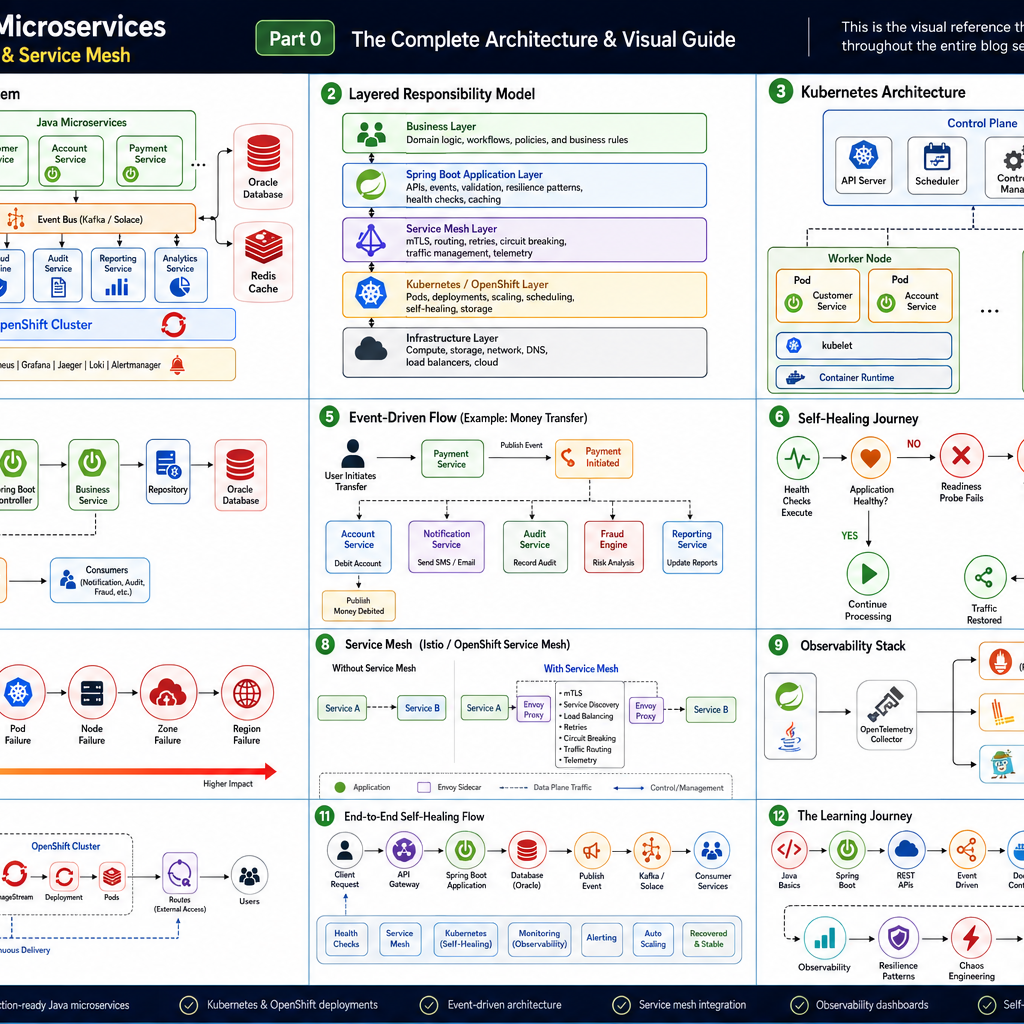
Recommended diagrams for the series
Section 1 – Foundations


- Monolith vs Microservices
- Cloud Native Stack
- Four Layers of Self-Healing
- Banking Reference Architecture
Section 2 – Kubernetes


Diagrams:
- Kubernetes Architecture
- Pod Lifecycle
- Deployment Flow
- Rolling Update
- Rolling Rollback
- ReplicaSet Recovery
- Node Failure Recovery
- Cluster Autoscaling
Section 3 – Spring Boot
- Spring Boot Startup Lifecycle
- Actuator Endpoints
- Graceful Shutdown Sequence
- Health Indicator Architecture
- Thread Pools
- Connection Pools
Section 4 – Event Driven Systems
- Event Choreography
- Event Orchestration
- Saga Pattern
- Outbox Pattern
- Dead Letter Queue
- Retry Topic
- Event Replay
- Duplicate Message Flow
- Exactly Once vs At Least Once
- Idempotency Flow
Section 5 – Service Mesh


- Envoy Sidecar
- Control Plane
- Data Plane
- mTLS Flow
- Retry Flow
- Traffic Mirroring
- Canary Deployment
- Blue Green Deployment
- Circuit Breaking
- Fault Injection
Section 6 – Observability
- OpenTelemetry Flow
- Distributed Trace
- Correlation ID Journey
- Metrics Pipeline
- Logging Pipeline
- Alert Flow
- SLI / SLO / SLA Relationship
Section 7 – OpenShift


- OpenShift Architecture
- Routes vs Ingress
- Security Context Constraints
- ImageStreams
- Operators
- GitOps Flow
Section 8 – Chaos Engineering
- Pod Kill Experiment
- Network Latency Injection
- Memory Leak Simulation
- Node Failure
- Zone Failure
- Recovery Timeline
Section 9 – End-to-End Banking System (Capstone)
This will be the signature architecture that evolves through the entire series.
It should show:
- API Gateway
- Authentication
- Customer Service
- Account Service
- Payment Service
- Notification Service
- Fraud Detection
- Audit Service
- Kafka/Solace Event Bus
- Redis Cache
- Oracle Database
- Service Mesh (Envoy)
- Kubernetes/OpenShift Cluster
- Prometheus
- Grafana
- Jaeger
- Loki
- Argo CD
- Helm
- HPA
- Ingress/Routes
- External Clients
As the series progresses, this single diagram will be expanded to illustrate each new capability, giving readers a consistent mental model rather than introducing disconnected examples.